





Download dem Warenkorb hinzufügen
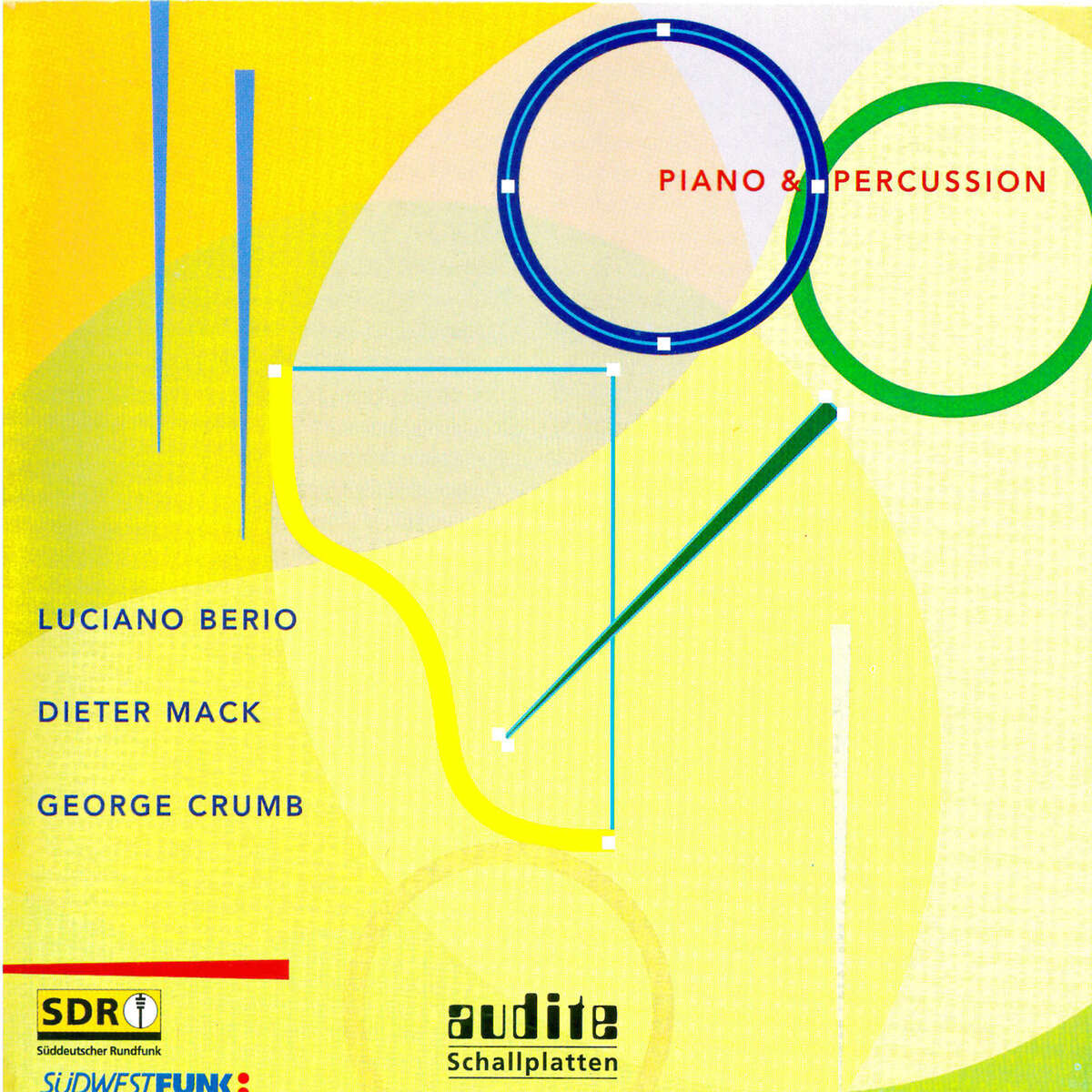

Luciano Berio | Dieter Mack | George Crumb
...

Titelliste
Details
| Piano & Percussion | |
| Artikelnummer: | 97.455 |
|---|---|
| EAN-Code: | 4009410974556 |
| Preisgruppe: | BCH |
| Veröffentlichungsdatum: | 1. Januar 1997 |
| Spielzeit: | 65 min. |
Besprechungen

www.musicweb-international.com | 01.01.2000 | Peter Grahame Woolf | 1. Januar 2000
Linea (1973) is one of Berio's happier creations of the early '70s. He takes a very simple 'melody' and explores its implied elements, the playersMehr lesen
Linea (1973) is one of Berio's happier creations of the early '70s. He takes a very simple 'melody' and explores its implied elements, the players sometimes diverging, at others meeting on the same line, the two pianos joined by marimba and vibraphone.
The German composer Dieter Mack (b.1954), who studied with Ferneyhough and Huber, and has a special interest in South-East Asian music, is likely to be the least known to readers. The title of his piece, composed whilst composer in residence in Wellington, alludes to personal relationships which develop and are disrupted participating in the water sport popular in the rapids of New Zealand. The percussion instruments used, with precision and quite sparingly, are helpfully listed in the detailed documentation with this CD, as are the many required for George Crumb's Music for a Summer Evening, the third part of his extended Makrokosmos. The first two volumes (1972-73) are for solo amplified piano, the title obviously relating to Bartók's Mikrokosmos. In his note, Crumb also acknowledges his debt to Bartók's Sonata for two pianos and percussion, expressing surprise that this fruitful combination did not lead to a rapid proliferation of works in that genre.
Makrokosmos III is a major work of approx. 40 mins (35 in this performance) for which the pianos are amplified and often set in a halo of evocative sounds, the odd-numbered movements on a large scale, with cosmic and philosophical programmes. They are separated by dreamlike intermezzi, a wistful Wanderer Fantasy mostly for the pianos alone, and Myth for the percussionists. Crumb's music is always easily accessible and often relatively simple - even simplistic in essence - its main constituent colouration from a wide sound palette of exotic instruments. The SDR recording is of demonstration quality.
The German composer Dieter Mack (b.1954), who studied with Ferneyhough and Huber, and has a special interest in South-East Asian music, is likely to be the least known to readers. The title of his piece, composed whilst composer in residence in Wellington, alludes to personal relationships which develop and are disrupted participating in the water sport popular in the rapids of New Zealand. The percussion instruments used, with precision and quite sparingly, are helpfully listed in the detailed documentation with this CD, as are the many required for George Crumb's Music for a Summer Evening, the third part of his extended Makrokosmos. The first two volumes (1972-73) are for solo amplified piano, the title obviously relating to Bartók's Mikrokosmos. In his note, Crumb also acknowledges his debt to Bartók's Sonata for two pianos and percussion, expressing surprise that this fruitful combination did not lead to a rapid proliferation of works in that genre.
Makrokosmos III is a major work of approx. 40 mins (35 in this performance) for which the pianos are amplified and often set in a halo of evocative sounds, the odd-numbered movements on a large scale, with cosmic and philosophical programmes. They are separated by dreamlike intermezzi, a wistful Wanderer Fantasy mostly for the pianos alone, and Myth for the percussionists. Crumb's music is always easily accessible and often relatively simple - even simplistic in essence - its main constituent colouration from a wide sound palette of exotic instruments. The SDR recording is of demonstration quality.
Linea (1973) is one of Berio's happier creations of the early '70s. He takes a very simple 'melody' and explores its implied elements, the players

Percussive Notes | February 1999 | John R. Raush | 1. Februar 1999 Percussion Projects
Composers have long been attracted to the sonic possibilities of anMehr lesen
Aus urheberrechtlichen Gründen dürfen wir ihnen diese Rezension leider nicht zeigen!
Composers have long been attracted to the sonic possibilities of an

Percussio Newsletter | 01.12.1998 | Nils Grammerstorf | 1. Dezember 1998
Das Stuttgarter Ensemble "piano & percussion" präsentieren zu ihrem·10-jährigen Bestehen, mit Aufnahmen die vom SWF und SDR produziert wurden, ihreMehr lesen
Das Stuttgarter Ensemble "piano & percussion" präsentieren zu ihrem·10-jährigen Bestehen, mit Aufnahmen die vom SWF und SDR produziert wurden, ihre erste CD. Neben den beiden "Klassikern", Berio's "Unea" und George Crumbs "Music for a Summer Evening" wurde auch, stellvertretend für eine ganze Reihe von Kompositionsaufträgen des Ensembles, Dieter Macks "Rafting and Beyond" aufgenommen. Die ganze Farbenvielfalt dieser schon als klassisch zu bezeichnenden Besetzung zeigt sich in der kompositorischen Strenge von Berios "Linea", in den Gamelan-Anleihen in Mack's Komposition bis hin zu Crumb's irisierenden Klängen. Da die Werke, mit leichten Abstrichen bei der SWF-Produktion, sehr gut aufgenommen worden ist, gestaltet sich dieses CD als ein absolutes Hörvergnügen.
Das Stuttgarter Ensemble "piano & percussion" präsentieren zu ihrem·10-jährigen Bestehen, mit Aufnahmen die vom SWF und SDR produziert wurden, ihre

Regensburger Wochenblatt | 2. September 1998 | 2. September 1998 Krieg der Klangwelten
Können konservative Gemüter zeitgenössische Klassik mögen? – SieMehr lesen
Aus urheberrechtlichen Gründen dürfen wir ihnen diese Rezension leider nicht zeigen!
Können konservative Gemüter zeitgenössische Klassik mögen? – Sie

Neue Zeitschrift für Musik | Juli / August 1998 | Hans-Werner Heister | 1. Juli 1998
Berios „Linea“ von 1973 klingt, bei etwas langsamerem Tempo undMehr lesen
Aus urheberrechtlichen Gründen dürfen wir ihnen diese Rezension leider nicht zeigen!
Berios „Linea“ von 1973 klingt, bei etwas langsamerem Tempo und

Fono Forum | 7/1998 | Franzpeter Messmer | 1. Juli 1998 Zeitgenössische Musik fesselnd interpretiert
Zum einen entdeckt das Publikum in den Werken der fünfziger bis achtziger Jahre unseres Jahrhunderts eine Kunst, die seinem Lebensgefühl entspricht,Mehr lesen
Zum einen entdeckt das Publikum in den Werken der fünfziger bis achtziger Jahre unseres Jahrhunderts eine Kunst, die seinem Lebensgefühl entspricht, zum anderer widmen sich Interpreten mit großem künstlerischen Engagement dieser mittlerweile auch schon historischen Musik. Nun steht Luciano Berio im Mittelpunkt von drei höchst unterschiedlichen Produktionen.
[…]
Geradezu klangmalerisch ist die CD von Susan Wenckus und ihren Kollegen. Sie betonen den Farbenreichtum Neuer Musik. Ihre Darstellung von „Linea" wirkt romantischer als die von Avantgarde, und Crumbs „Music for a Summer Evening" fesselt durch den vielfältigen Reiz der Naturlaute und archaischen Klänge, die mit erstaunlicher Klarheit einander gegenübergestellt werden.
[…]
Geradezu klangmalerisch ist die CD von Susan Wenckus und ihren Kollegen. Sie betonen den Farbenreichtum Neuer Musik. Ihre Darstellung von „Linea" wirkt romantischer als die von Avantgarde, und Crumbs „Music for a Summer Evening" fesselt durch den vielfältigen Reiz der Naturlaute und archaischen Klänge, die mit erstaunlicher Klarheit einander gegenübergestellt werden.
Zum einen entdeckt das Publikum in den Werken der fünfziger bis achtziger Jahre unseres Jahrhunderts eine Kunst, die seinem Lebensgefühl entspricht,